
い-adjective
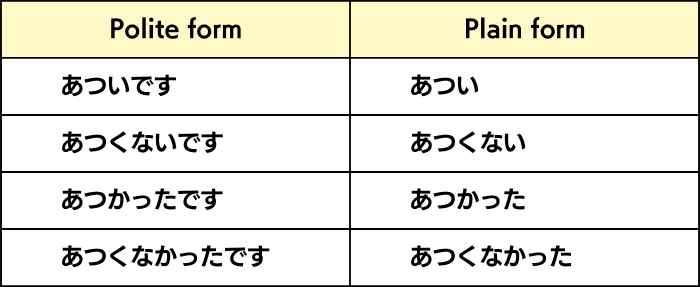
Plain form
- A conjugation of Japanese い-adjectives, which is used to modify nouns to describe their characteristic or properties in a casual style.
- Conjugated for tense (present or past) and affirmative/negative, and each form is created by omitting です from the polite form.
- The plain form is often used among friends and family members, while the polite form is often used in business settings or other formal situations.
Example Sentences
-
今年の夏は、とても暑い。This summer is very hot.
-
最近の雑誌は、あまり面白くない。The magazines these days are not very interesting.
-
あの店のお寿司は、おいしかった。The sushi at that restaurant was delicious.
-
荷物は、あまり重くなかった。The luggage was not too heavy.
-
一緒に行く? ー いいの?行きたい 。Do you want to go together? - Is it okay? I want to go.
Tags
JLPT N5