
Verb
Passive form 〜られる
- A conjugation of Japanese verbs, which is used to indicate that the subject of the sentence is receiving the action rather than performing it.
- To form the passive form of a verb, follow the following three rules depending on the verb group:
- Group 1: Replace the ending u-vowel with the a-vowel and add れる.
- Group 2: Replace the ending る with られる.
- Group 3: Follow the unique rule.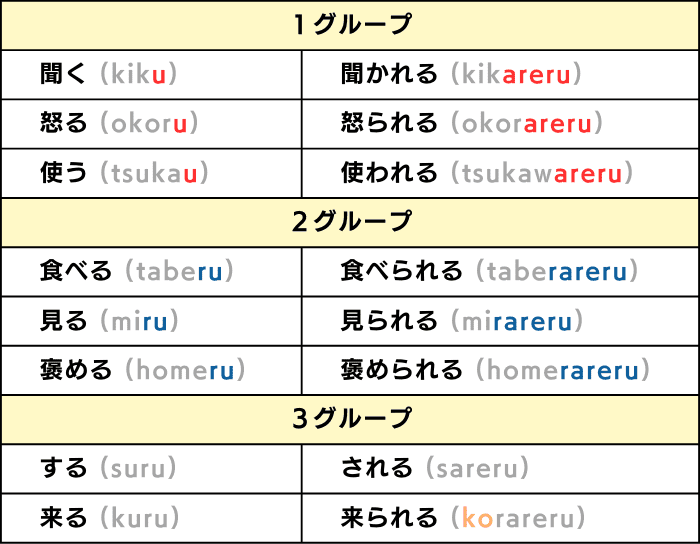
- The passive form is often used in the following pattern:
[Receiver] は [Giver] に [Object] を V(passive)。
- V(passive): An action described by the passive-form verb
- Receiver: A person (or thing) who receives the action
- Giver: A person (or thing) who does the action
- Object: An object that is affected by the action (if exist) - The particle に, which marks the giver, is sometimes replaced with the particle から when the sentence has two に particles, or with によって in a formal context.
Meaning
be done by someone
Example Sentences
-
私は、先生に褒められた。I was praised by my teacher.
-
私は、母に叱られました。I was scolded by my mother.
-
警官にビザについて、聞かれた。I was asked about my visa by the policeman.
-
妹は、父に怒られた。My younger sister was scolded by our father.
-
兄に、恋人の写真を見られました。My older brother saw a picture of my girlfriend.
-
まだです。店員さんに、パスポートの色や形を聞かれました。Not yet. The clerk asked me what color and shape my passport was.
Tags
JLPT N4