
Verb
ます-form (Present Affirmative)
- A conjugation of Japanese verbs, which is also known as the polite form of verbs and used to describe an action or event in a polite style.
- Conjugated for tense (present or past) and affirmative/negative, and its present affirmative form describes a regular, habitual, or future action or event.
- To form the ます-form, follow the following three rules depending on the verb group:
- Group 1 (1グループ): Replace the ending u-vowel with the i-vowel and add "ます".
- Group 2 (2グループ): Replace the ending "る" with "ます".
- Group 3 (3グループ): Follow the unique rule.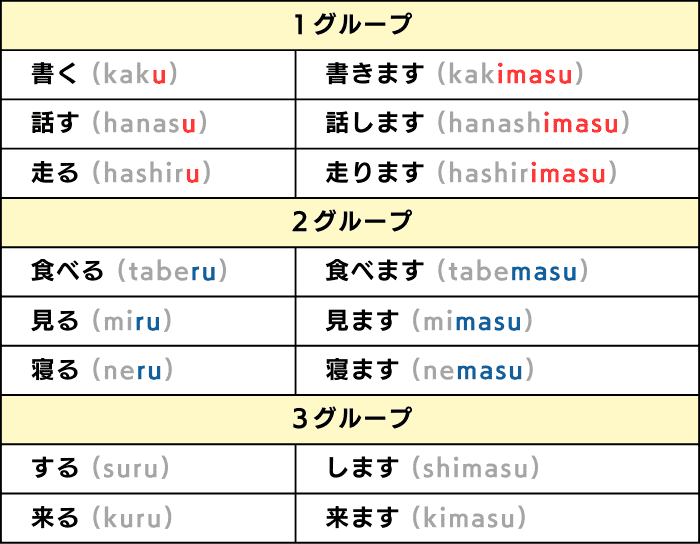
- Note that the "ます-form" indicates both the complete verb word including "ます" (e.g. 書きます) and the stem of the verb after removing the final "ます" (e.g. 書き), which is called ます-stem in some textbooks.
Example Sentences
-
私は、毎日、パンを食べます。I eat bread every day.
-
大学の先生は、いつも、英語で話します。The university professor always speaks in English.
-
私の父は、来月、カメラを買います。My father will come to Tokyo next month.
-
いつもバスで学校へ行きます。I usually go to school by bus.
-
明日、富士山に登ります。Tomorrow, I will climb Mount Fuji.
-
エマさん、荷物を持って行きますか。ロッカーに置きますか。Emma, are you taking your luggage with you? Or will you put it in the locker?
Tags
JLPT N5