
Verb
た-form
- A conjugation of Japanese verbs, which is also known as the past tense form of verbs and used to describe a past action or event in a plain style.
- To form the た-form of a verb, there are several rules depending on the verb group and the last character of the verb:
- Group 1 (1グループ): If the last word of a verb is う / つ / る, replace it with った. If it's ぬ / ぶ / む replace it with んだ. If it's す, replace it with した. If it's く, replace it with いた. If it's ぐ, replace it with いだ. However, 行く becomes the exception 行った.
- Group 2 (2グループ): Replace the ending る with た.
- Group 3 (3グループ): Follow the unique rule.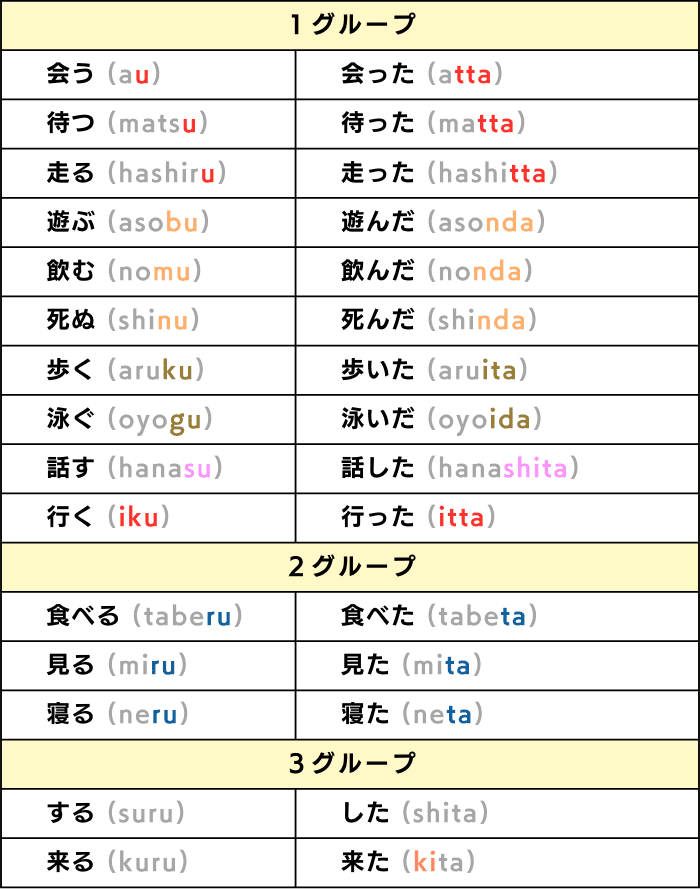
- Note that the "た-form" indicates both the complete verb word "verb + た" (e.g. 書いた) and the stem of the verb after removing the final "た" (e.g. 書い).
Example Sentences
-
昨日、母と二人で出かけた。Yesterday, I went out with my mother.
-
先週、雪が降った。It snowed last week.
-
雨が止んで、晴れた。The rain stopped and it became sunny.
-
昨日、友だちに会った。I met my friend yesterday.
-
2年前、ヨーロッパを旅行した。I traveled to Europe two years ago.
-
市場を歩いて、日本のおすしを食べた。We walked through the market and ate Japanese sushi.
Tags
JLPT N5