
Noun
Plain form
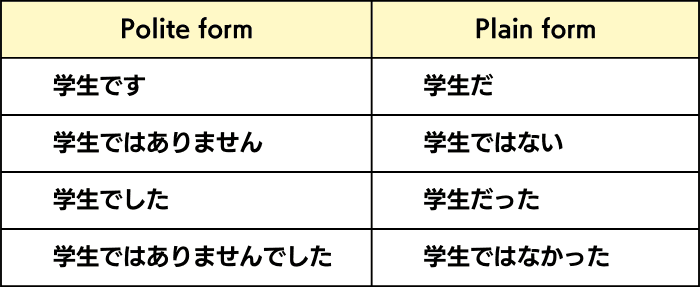
N + だ N + ではない(じゃない) N + だった N + ではなかった(じゃなかった)
- A pseudo conjugation of Japanese nouns, which is used to describe the state of someone or something in a casual style.
- The plain form of nouns is created by adding だ to them, and だ can be conjugated to show tense (present/past) and positive/negative, such as だ / ではない(じゃない) / だった / ではなかった(じゃなかった).
- The plain form is often used among friends and family members, while the polite form is often used in business settings or other formal situations.
Example Sentences
-
私は、会社員だ。I'm an office worker.
-
そこは、ロッカーではない。It's not a locker there.
-
彼女は、この大学の学生だった。She was a student at this university.
-
昨日は、雨ではなかった。Yesterday, it was not raining.
-
今日の晩ご飯はカレーじゃなかった。Dinner today wasn’t curry.
Tags
JLPT N5