
Verb
Volitional form 〜よう
- A conjugation of Japanese verbs, which is used to express the speaker's volition to do something.
- It is often used to make suggestions or invitations to others in a friendly way or to talk to oneself.
- The polite form of the volitional form is "〜ましょう", which is often used in formal context.
- By adding any of the sentence-ending particles "か", "よ", or "ね" to the volitional form, the nuance of encouraging the other person to take action together becomes stronger.
- To form the volitional form of a verb, follow the following three rules depending on the verb group:
- Group 1: Replace the ending u-vowel with the o-vowel and add "う".
- Group 2: Replace the ending "る" with "よう".
- Group 3: Follow the unique rule.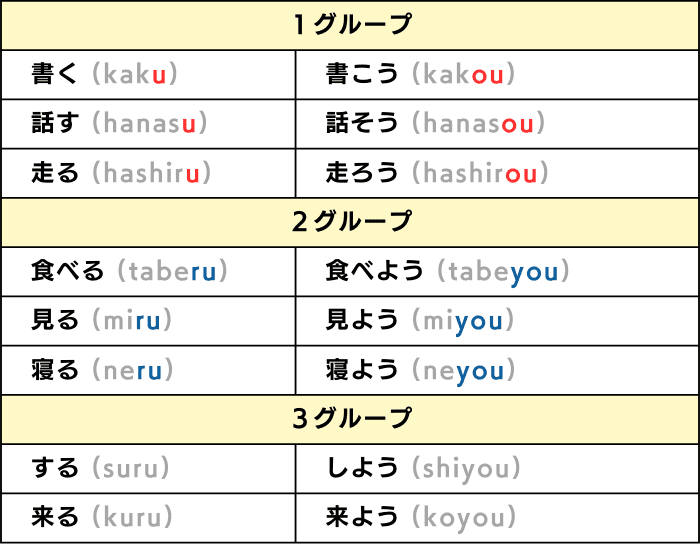
Meaning
let's; I will
Example Sentences
-
家に帰ったら、掃除しよう。I'll clean up when I get home.
-
今日から、ひらがなを練習しよう。I'll practice hiragana starting today.
-
富士山に登ろう。 ー いいね!再来週行こうよ。Let's climb Mt. Fuji. - Sounds nice! Let's go the week after next.
-
明日は早く起きようね。Let's wake up early tomorrow, okay?
-
今日は帰って、ゆっくり家で休もう。Let's go home today and relax at home.
-
これから、日本語で日記を書こう。From now on, I will try to write a diary in Japanese.
-
お金をもらったら、新しいゲームを買おう。When I get money, I'll buy a new game.
-
今晩、家に帰ったら、絶対に掃除しよう。When I get home tonight, I will definitely clean.
-
もう夜10時だ! ー じゃ、帰ろうか。It's already 10 PM! - Well, shall we go home?
-
じゃ、私はサンドイッチとコーヒーを頼もうかな。Then I'll order a sandwich and coffee.
-
よし、エマさん!一緒に売り場を見に行こう!Okay, Emma! Let's go look at the counter together!
-
午後、公園に行こう。 ー ううん、行かない。Let's go to the park in the afternoon. - No, I won't go.
Tags
JLPT N5