
Verb
Causative-Passive form 〜させられる
- A conjugation of Japanese verbs that combines the causative form and the passive form.
- It is used to express the idea that someone is made to do an action (causative) and, at the same time, becomes the receiver of the action (passive).
- It is often implies that an action is performed against the speaker's will or as a result of external influence.
- To form the causative-passive form of a verb, follow the following three rules depending on the verb group:
- Group 1: Replace the ending u-vowel with the a-vowel and add せられる or される.
- Group 2: Replace the ending る with させられる.
- Group 3: Follow the unique rule.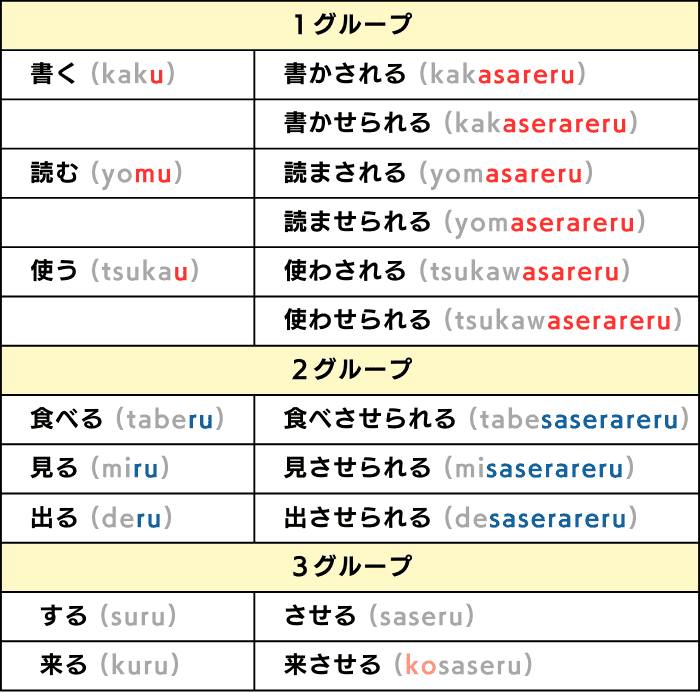
- The causative-passive form is often used in the following pattern:
[Actor] は [Causer] に [Object] を V(causative-passive)。
- V(causative-passive): An action described by the causative-passive-form verb
- Actor: A person (or thing) who does the action
- Causer: A person (or thing) that causes the actor to do the action
- Object: A thing (or person) that is affected by the action
Meaning
cause someone to do; make someone do
Example Sentences
-
おととい、父に重いテーブルを持たされました。The day before yesterday, my father made me carry a heavy table.
-
母に3階まで椅子を運ばされ、そこに並べさせられた。My mother made me carry the chairs to the third floor and arrange them there.
-
会議では、部長に何でも無理に賛成させられた。At meetings, I was forced to agree to everything by my manager.
-
先生に100回も漢字を書かされました。The teacher made me write kanji 100 times.
-
子どもの時、母に野菜を食べさせられました。When I was a child, my mother made me eat vegetables.
-
けんには、びっくりさせられましたよ。Ken gave me a surprise.
Tags
JLPT N4