
Verb
Potential form 〜れる
- A conjugation of Japanese verbs, which is used to indicate one's ability to do something or the state of being capable of performing a particular action.
- To form the potential form of a verb, follow the following three rules depending on the verb group:
- Group 1: Replace the ending u-vowel with the e-vowel and add る.
- Group 2: Replace the ending る with れる.
- Group 3: Follow the unique rule.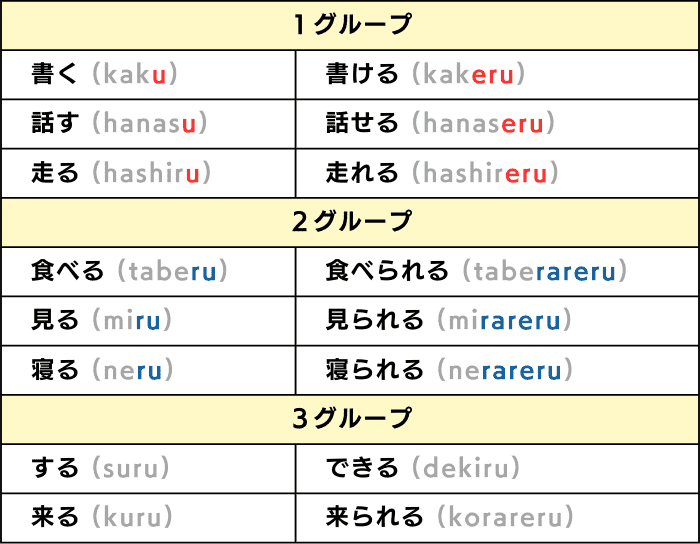
- It is often used in the pattern "N が + V(potential)".
Example Sentences
-
小さな木の枝で、ネックレスが作れます。You can make a necklace from small tree branches.
-
あの公園では、象にえさがやれます。You can feed the elephants in that park.
-
このナイフは、どんなに固い野菜も切れる。This knife can cut even the hardest vegetable.
-
私はお酒が飲めます。I can drink alcohol.
-
私は、魚が食べられません。I cannot eat fish.
-
この携帯では、メールできません。I cannot send emails with this mobile phone.
-
おいしい日本料理や、美しい自然が楽しめるところへ行きたいです。I would like to go to a place where I can enjoy delicious Japanese food and beautiful nature.
-
近くに、おいしい天ぷらが食べられるところもありますよ。There is a place nearby where you can eat delicious tempura.
-
明日学校に来られますか。Can you come to school tomorrow?
Tags
JLPT N5