
Verb
Causative form 〜させる
- A conjugation of Japanese verbs, which is used to indicate that someone causes or allows someone else to do an action.
- To form the causative form of a verb, follow the following three rules depending on the verb group:
- Group 1: Replace the ending u-vowel with the a-vowel and add せる.
- Group 2: Replace the ending る with させる.
- Group 3: Follow the unique rule.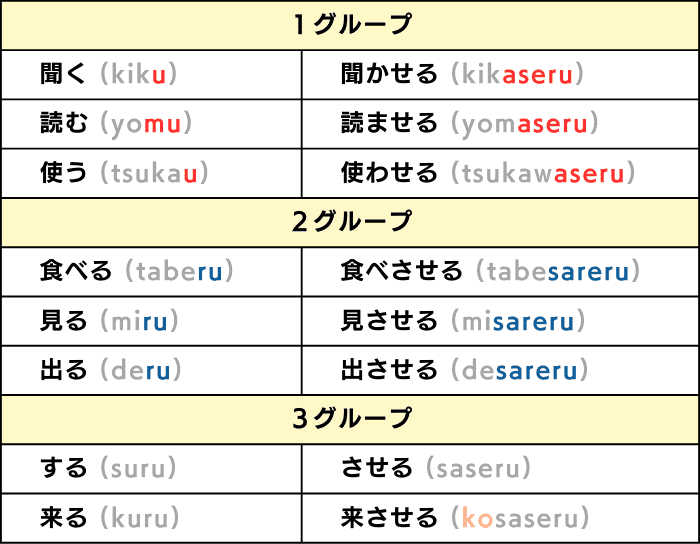
- The causative form is often used in the following two patterns:
In the case of Intransitive verbs (with no direct object):
[Causer] は [Acter] を V(causative)。
In the case of transitive verbs (with a direct object):
[Causer] は [Actor] に [Object] を V(causative)。
- V(causative): An action described by the causative-form verb
- Actor: A person (or thing) who does the action
- Causer: A person (or thing) that causes the actor to do the action
- Object: A thing (or person) that is affected by the action
Meaning
cause someone to do; make someone do
Example Sentences
-
先生は、学生を立たせました。The teacher made the student stand up.
-
飲み会で、部長は田中さんを踊らせました。At a drinking party, the director made Tanaka-san dance.
-
母は、私に、弟の服を変えさせました。My mother made me change my younger brother's clothes.
-
社長は、山田さんに、壁に絵を掛けさせた。The president made Yamada-san hang a picture on the wall.
-
お母さんは、子どもを歯医者に行かせた。The mother made her child go to the dentist.
-
母は、子どもに野菜を食べさせた。The mother made her child eat vegetables.
-
父は私に、本を読ませました。My father made me read a book.
-
お酒をたくさん飲ませるのはよくないです。It's not good to make someone drink a lot of alcohol.
-
子どもの頃、父は僕に剣道や柔道を習わせました。When I was a child, my father made me learn kendo and judo.
-
それなのに、毎週、父は僕を練習に行かせました。And yet, my father made me go to practice every week.
Tags
JLPT N4